
A good kindergarten is not just colorful walls, an exciting outdoor area or modern toys. A good kindergarten is born from how well-thought-out everyday life is organized, how visible the focus on the child's well-being is, and how teachers are truly listened to. Kohila Sipsiku Kindergarten is a place where systematicity and human warmth are not opposites, but go hand in hand. Here, things are not done simply because "it's always been that way", but rather they are consistently asked: why are we doing this and how does it really support the child?
At Sipsiku, teachers have a lot of autonomy: goals are set together, but the journey to them is up to the group to choose. The school year's action plan formulates major focuses that this year concern both children's self-regulation and staff self-management, but the teachers themselves choose specific tools and methods. The management does not lead from the “top down”, but creates space for meaningful cooperation: development days, regular small meetings, a coaching program and friendship groups – all so that everyone can truly participate, learn and contribute. The attitude is important: problems are seen as challenges, to which solutions are sought together.
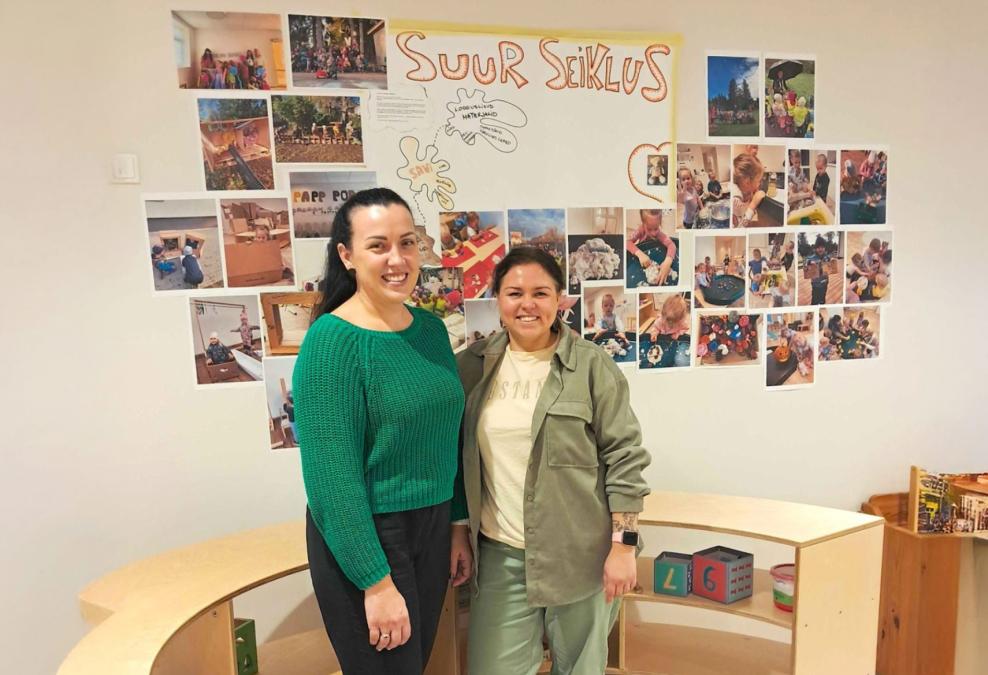
At the heart of this story are two teachers from Sipsik – Teele, a teacher awarded the republican title “Kindergarten Teacher of the Year 2025”, and Helina, a teacher with a “creatively positive” attitude. Together with them, we will look for the answer to the question: what makes Sipsik a good kindergarten, where it is pleasant to work and where children have a safe, exciting and real-life childhood?
What makes Kohila Sipsik a good and cool kindergarten where it is pleasant to work?
Teacher Teele:
“Our Sipsik is cool because the work is really systematic. Nothing is done just for the sake of doing it – we always ask why we are doing it and how it really supports the child. As a teacher, I have a lot of autonomy.”
“We are constantly involved in defining the vision, mission and values – it is not simply ‘top-down’, but we create it together.”
“There are many opportunities and cooperation works well. A way of thinking has developed here: we do not see problems, but challenges, and we focus on solutions. Previous experiences in different systems help me understand very well why things are so good today.”
In what do you think this autonomy is most reflected? Can you give any specific examples?
Teacher Teele:
“The simplest example is work schedules and group work organization. We don’t have a rigid predetermined plan – there is a reasonable framework, but as a group leader I can adjust the schedule as needed.”
Practical flexibility:
If there are fewer children in the morning or there are illnesses, the assistant teacher can come later.
The free time can be directed to self-development or used on another day when “SOS” and extra hands are needed.
This requires agreements with the team. For some, a solid structure is very important, but flexibility works well in cooperation.
“We set big goals in the annual plan. This year, for example, we are supporting children’s self-regulation and self-management skills, and at the same time, employees’ self-management. How someone in the group reaches these goals, what tools and methods they use is the free choice of the group team. The goal is clear, the journey can be different. That’s what autonomy is to me.”
“The goal is common, the method is free – this way the focus remains on the child and the team uses its strengths.”
Teacher Helina, please describe the team culture at Sipsik. What keeps your team spirit alive – both in the Põnnipere house and in the entire kindergarten?
Teacher Helina:
“In terms of maintaining it, we start together every autumn. At the end of August, we have a development day – actually twice a year. It’s really good to take a whole day at the beginning of the season, where everyone who works together can get together. When we opened a new house, we came here: others could learn, share thoughts and a common picture. Together, we set the year’s focuses, plans, and get to know new employees. This creates a clear platform for what to expect from the new year.”
How does this created platform actually apply in everyday work?
Teacher Helina:
“Regular thinking and reflection together. We have staff meetings every few weeks. Teachers and teaching assistants meet on two different days so that the groups are smaller and the discussions are more meaningful. We exchange knowledge, talk about concerns, share ideas. We also use these meetings to raise awareness – mini-trainings are literally brought ‘to your home’. You come during your normal working day and take small, consistent steps.”
“The key is open communication: the courage to ask, notice, give feedback.”
Teacher Helina (continues):
“Clarity of roles is very important. What is expected of whom as a group member, what are the areas of responsibility. If something is confusing, we talk it through. We are also supported by a coaching program with an external supervisor. Personally, I had not been involved in such a process before, but I immediately saw how essential it is. This helps to bring to the surface what is really happening in the team without ‘long talks’ and you look at yourself from the sidelines.”
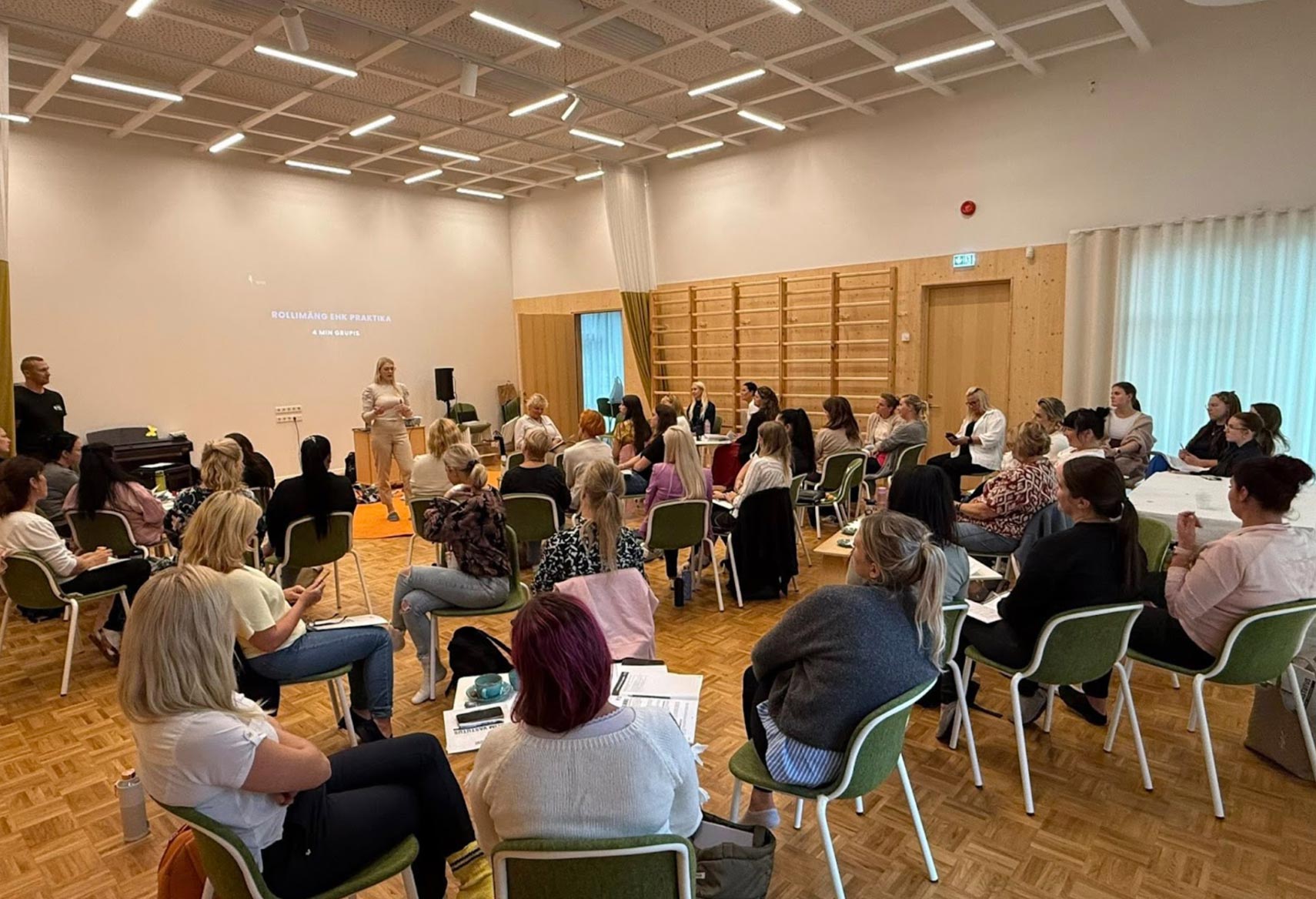
Training at Sipsik Kindergarten
This sounds like a sign of strong management – regular reflection, training “on the spot”, transparent work process. How do you perceive it, does Sipsik have good and strong management?
Teacher Teele:
“We have a great management team. Training comes based on needs – not just ‘something happens’, but a real approach based on the needs of the employees. Meetings are active and the staff is not just in the role of receiver of information, but we think and create a common practice. At first I came from a different system and expected ‘the manager to tell me what to do’. Here I understood what inclusive management really is.”
How does it actually work so that everyone can really get involved in these discussions and study circles?
Teacher Teele:
“We have friendship groups: if one group has a meeting or a study group during lunch break, the ‘friendship group’ covers the work of the other group at that time. The next day there is a shift – so everyone can participate. In addition, there is a ‘group friend’ who is available to each group from outside the group – often from the management. If I need a discussion time with the team for a lesson, we make an appointment with him or her and the group friend comes to help. It is very systematic and functional.”
You mentioned before the interview that you have a lot of visitors and observers. How does this affect classroom life?
Teacher Teele:
“There are really a lot of visitors, but it is the management’s decision how and when to receive them. At some point in my group, I felt that there were too many interruptions and this affected the children’s rhythm. I said so. Now the visits are coordinated with me much more precisely – to maintain a smooth agenda and a calm rhythm. The feedback was quickly taken into account.”
Teacher Helina:
“Exactly – if there is a concern, we are listened to and corrections are made. This creates a sense of security.”
If you were in the management, what would you do differently?
Teacher Teele:
“To be honest, it is difficult for me to say what should be done differently now. When I came to Sipsikus, it was unusual for me to have the opportunity to decide and contribute so much myself – now I understand why this is the case and why it works. I feel that the management is very conscious in their choices.”
Teacher Helina:
“I agree. If there are ‘places for change’, it is more likely in the rules and laws at the state level, not in the management of our house. Internal feedback is taken into account quickly.”
Key points that keep the culture strong
Development days twice a year: common focus, roles, looking back and forward.
Small and regular meetings: knowledge exchange, discussion of concerns and sharing of good practices, mini-trainings.
Coaching program: reflection with the support of an external supervisor and making team processes visible.
Clarity of roles and open communication: dare to ask, notice, give feedback and communicate.
Friendship groups and group friends: a system that allows everyone to learn and participate in discussions.
Conscious coordination of visits: children’s well-being and a smooth rhythm come first.
Teacher Teele, you were recently recognized at the national level with the title of “Kindergarten Teacher of the Year 2025”. Congratulations! What were the most exciting moments of this journey? And has it changed your everyday life?
Teacher Teele:
“I wouldn’t have made it this far if I hadn’t come to work at Sipsiku Kindergarten. This is where a big change began as a teacher – a deeper understanding of my work. I learned to ask difficult questions when I didn’t understand something; to try differently and focus not on problems but on solutions; to think about both my own and my children’s learning process: what we do, why we do it and what is the most effective way to do it.”
What supported the growth of this understanding?
Teacher Teele:
“The master’s studies gave me a broader picture. And of course our Sipsiku team. I guess I stood out in the way I managed my small team and worked with the children. My questions often brought up discussions that others had in mind, but that others had not yet asked.”
How did this recognition formally reach you?
Teacher Teele:
“It all started with an internal recognition at Sipsiku – I was chosen as our kindergarten teacher of the year. The entire staff was behind it. I received overwhelming support and people came to me personally to say: ‘I voted for you.’ It touched me deeply. Based on these steps, the director put together my candidacy and nominated me for the republican title. I feel like it was a community recognition.”
What moment do you remember most?
Teacher Teele:
“At the beginning of September, I received a letter from the Ministry of Education and Research: ‘Congratulations, you are among the three nominees.’ I thought, what a joke this is – how did this happen? (laughs) And then the win came. The most special thing was that the award was presented by my (my own group) children. When Rebeka and Johannes came on stage, I couldn’t even recognize them in the darkness at first – both of them were so festive. I just wanted to be on stage with them.”
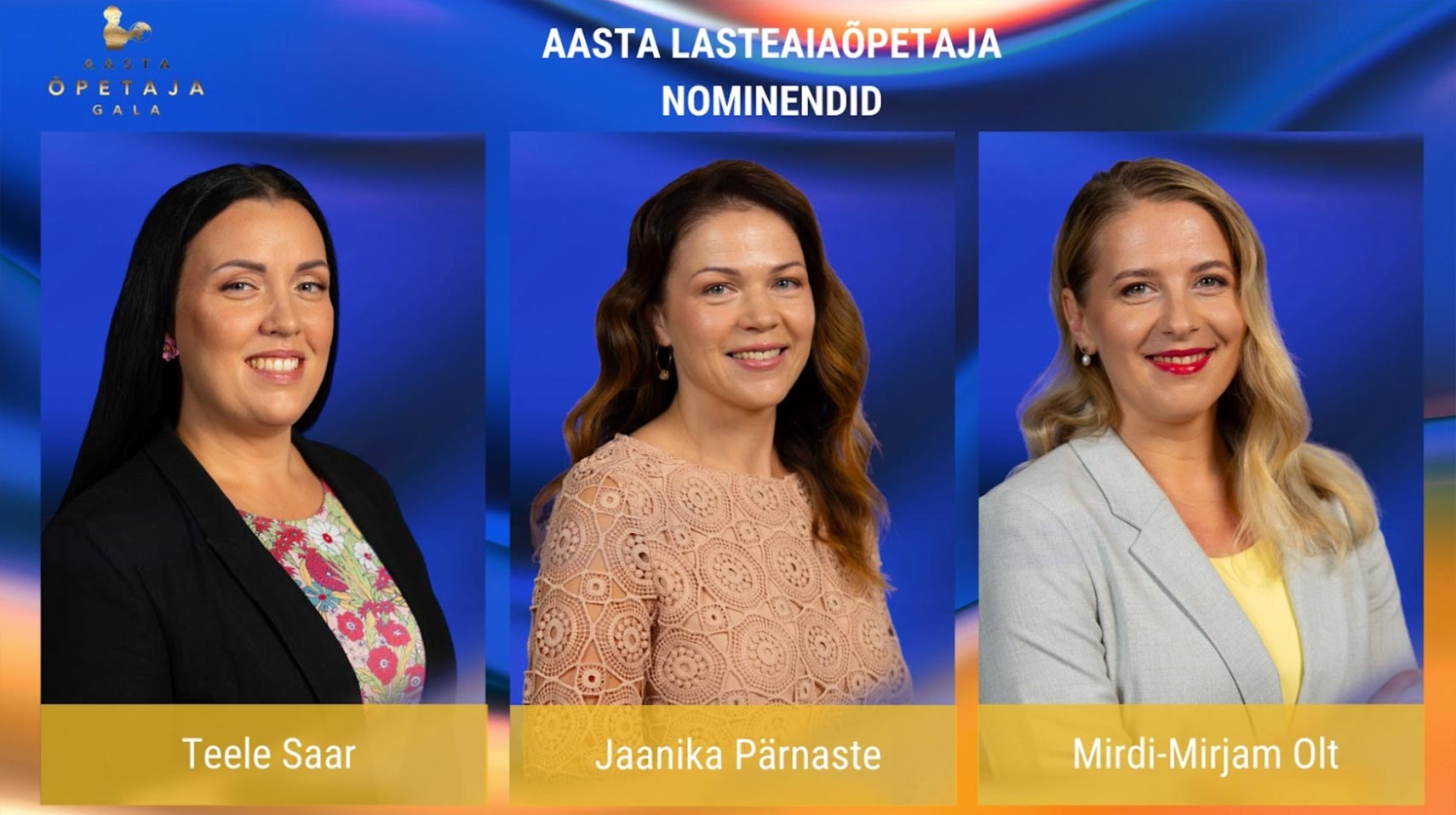
Teele Saar - kindergarten teacher of a year 2025 in Estonia
The children were also asked for feedback about you, do I understand?
Teacher Teele:
“Yes. Our special education teacher Janne Rannala and principal Kristina Mägi collected thoughts from the children in the group ‘what kind of Teacher Teele is?’. A meaningful text was compiled from the children’s stories, which Rebeka and Johannes presented on stage. It gave the feeling that I had done something very right somewhere. I felt that this joy and pride could also be accepted, even if I wanted to be modest in my Estonian way.”
Has anything changed in your daily life?
Teacher Teele:
“The main change is visibility – more interviews and interest in the activities of our kindergarten and the group. But the content is the same: meaningful, consistent work, experiencing, asking, experimenting and supporting children’s learning. The title was not the goal; I just always tend to do a little more than expected.”
While studying previous materials, I noticed that you are described as an experienced supervisor. Is this true?
Teacher Teele:
“It’s relative (laughs). The management sees me as an experienced supervisor, even though I’ve only worked at Sipsik for two years. During that time, I’ve had several supervisions: the Ukrainian experience, interns from Ida-Virumaa, and job shadowing, who moved towards Estonian-language teaching. So there’s a lot of experience in that short time.”
If you’ve supervised teachers from different backgrounds, what advice have you given? Are there any ideas that you would recommend to all kindergartens in general?
Teacher Teele:
“Every supervision is different – the needs are different. But two very practical things have clearly justified themselves in our group.”
1) Morning circle before breakfast – a rhythm that keeps focus
“More traditionally, morning circle takes place after breakfast, from which we move on to the following activities. For us, morning circle works better before breakfast. In addition, there is a lunch circle before lunch and an evening circle before the evening meal – these are often led by assistant teachers. The circle activities include small learning activities and games, as well as conversations on topics that are currently causing joy or concern. Children know that there is a small circle before each meal – this creates a safe rhythm for the whole day.”
2) “Peace Nests” – self-regulation when things are calm
“I highly recommend creating a peace nest and practicing self-regulation when everything is fine – not only in times of crisis.
It is important that it is not just a ‘corner’, but a place created and thought out together with the children: what is it for, how and when to use it, what steps help there (breathing exercises, muscle tension-relaxation, articulating feelings, etc.). This is how a peace nest really works. I have been very inspired by the experience of Ilmatsalu kindergarten Lepatriinu, their head teacher Liis-Marii Võik is one of the leaders of the peace nests theme.”
Sounds like simple, yet systematic steps.
Teacher Teele:
“Exactly. A rhythm before meals and a well-thought-out quiet space – these are small changes that make a very significant difference in the big picture.”
Helina, I read about you on Kohila municipality social media and they wrote about you as a “creatively positive” teacher. What does that mean to you?
Teacher Helina:
“For me, it means two things together: creativity + conscious focus on the good. I notice what is already working, not just what is not working well. When someone shares strong feelings, I ask myself: is this a topic that we need to deal with in depth, or something that I won’t remember in three months. This way I keep a calm line in the team and group – we explain real topics, not drowning in every momentary emotion.”
What practices have you brought to your group that are different or have a particularly good effect?
Teacher Helina:
1) “Prickly-hedgehog” – the team’s code word.
“If someone is struggling, there’s no need for a long explanation. You just say ‘prickly-hedgehog’ – that’s our agreed code word. Others know: take 10 minutes, we’ll cover. This keeps adults functioning as a team and prevents burnout.”
2) Outdoor learning as the default mode.
“We have an ideal outdoor environment, so we are an outdoor kindergarten – we come indoors to sleep and do hygiene, and we do the rest as much as possible outdoors. This summer we completed practical training at the School of Architecture and designed a free play area for children – ‘my land, my place, my game’. The child knows that they can come back to the game, develop it further and involve others. This supports social skills, self-regulation and creativity in a very comprehensive way. We have it ready now and the children want to go outside.”
Sipsiku Kindergarten has two buildings, one large and one small. You both work in different buildings. Helina, you used to work in a large building, but now you work in a small building. Can you point out any differences between a large and a small building?
Teacher Helina:
“The large building gave me a good moment of comparison – lots of groups, lots of people, every corner used as ‘nests’. When I came here, I felt how big the difference is: in a small building, the closeness, pace and relationships are different. This experience helps me to really appreciate and value this environment.”
Helina, you mentioned earlier that changes would need to be made more at the national level. Let’s imagine that the people of the Ministry, and why not the Minister himself, were to read the ELIIS blog, so what would you ask the Ministry to change?
Teacher Helina:
“Group size. There are more and more children with special needs in regular groups, too, the group dynamics are changing, and the adult support system is not catching up as quickly. Fewer children in the group would allow us to really reach every child at a calm pace.”
Teacher Teele (adds):
“There are even more issues in society. The Norwegian example spoke to us: kindergarten days are shorter, parents have time, the kindergarten doors are closed by 5 p.m. This is a cultural change, but it affects calmness and brings the value of family time into focus. It also helps us now that we work a lot in small groups and the one-teacher system works with strong assistant teachers – but the volume is still high.”
One topic I often touch on is the teacher system in the group. What system is in Sipsiku kindergarten? 1+2 or 2+1?
Teacher Teele:
“We have 1+2. I have also worked in a 2+1 system and at that time I personally liked it – two 12-hour days and one 6-hour day gave me work, in terms of life balance it created a nice rhythm. However, if I focus on what is most important, i.e. the children's needs and thus on working in small groups, then 1+2 supports the children better. There are more adults during the most intensive time, we achieve the goals more smoothly and it is easier to support children with more difficult behavior.”
What is the most important thing about 1+2 from a teacher's perspective?
Teacher Teele:
"That the teacher recognizes himself as the team leader. If it is not clear who is keeping the course, friction will arise. This does not mean that 'I tell you what's up' - on the contrary, inclusive leadership is key here too: we take the assistant teachers as real partners, create clarity in roles, set common goals."
But why is the 2+1 system still preferred in some places?
Teacher Teele:
"Often because of the conveniences in work organization - long shifts, a more specific personal rhythm. Pedagogically, in my experience, 1+2 is more flexible: more hands and eyes when the children need it most."
“I jokingly say that 2+2 or 1+3 – it feels like one person is still missing (laughs). More seriously: last year’s experience, when we were provided with a group-wide support person, made a big difference. The support person was not tied to one child, but supported the entire group. This way, it was easier to cover, for example, flexible rest time and offer preschoolers who no longer need sleep time for quiet activities with alternative activities. This year, this resource is not there and there are definitely more challenges.”
Teacher Helina:
“In addition to ideals, a very clear division of roles and agreements help – for example, our code word “thorn-hedgehog” between adults, that someone can take a 10-minute ‘breather’ and the others will cover. This keeps the team in working order even when the day gets crazy.”
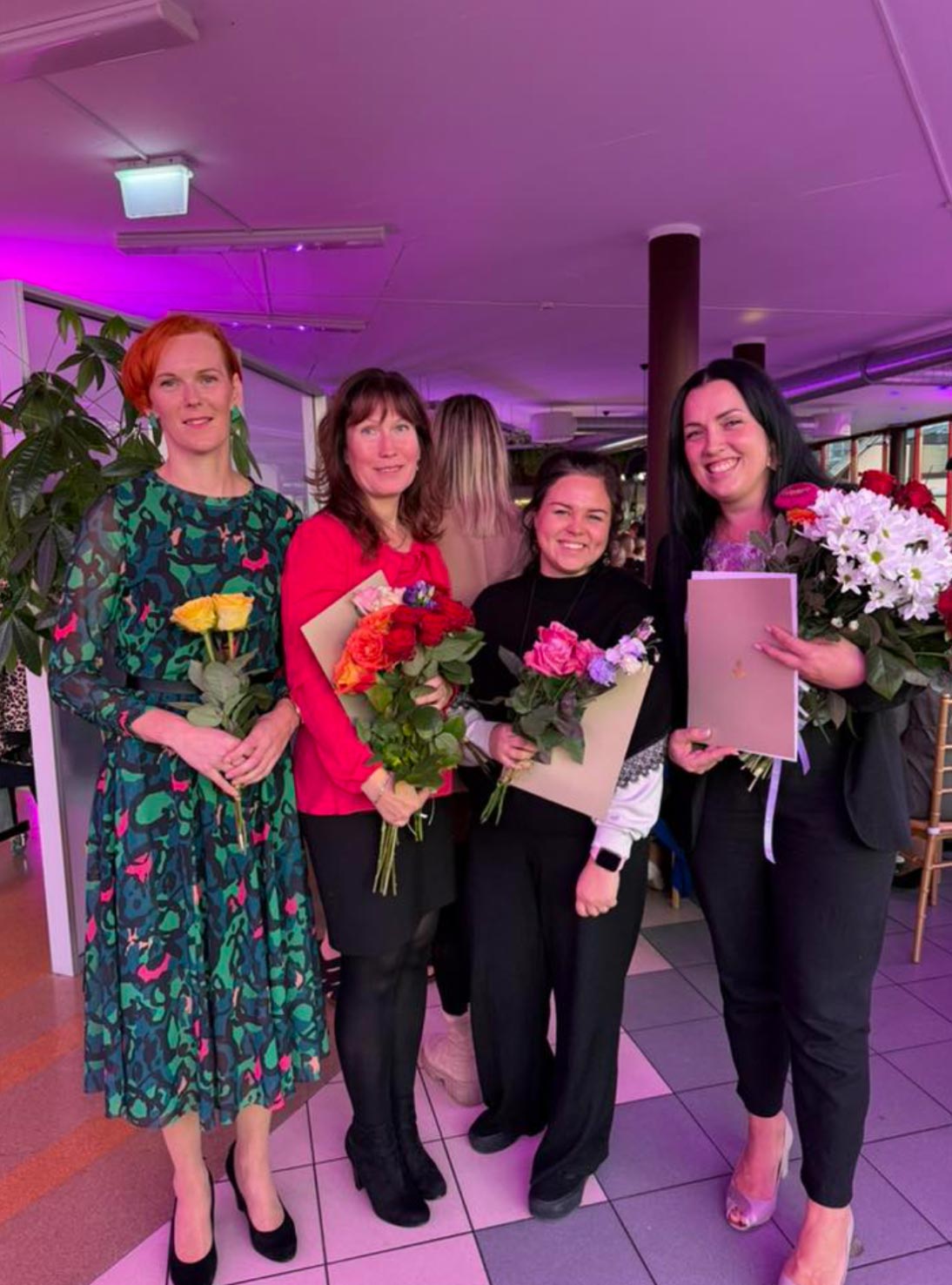
Recognitions on Teachers' Day
Let's talk about project-based learning. How do you ensure that children are truly leaders of the process, not “followers”?
Teacher Helina:
“We currently have a materials project in our group. We start by giving children different materials, observing what they do with them themselves, and only then do we discuss: what else can be done with this material, how to “manipulate” it. The younger ones (2+) start by touching and sniffing, the older ones (3 - 4) are already building and playing. The topic comes from the children's interest. If we see that interest is fading, we bring new material. When we talk about a material, we always discuss where it comes from, how we get it, and involve the parents.”
Example 1: cardboard
“The parents brought boxes, tubes, rolls – a whole ‘cardboard city’ was born. For the children, it is “my place, my game”, where they can come back the next day and develop it further.”
Example 2: clay + real experience.
“There is a pottery factory right next door. With the help of a parent, we arranged a visit: the children saw the process and the world of work from start to finish: how people really work. Later, we made an object from clay ourselves, fired it, and the finished thing was finished. The child feels the whole journey, not just the ‘result’.”
How do we “make sense of it visible”?
Teacher Helina:
“We use “talking walls” – we map the journey on the wall: pictures, sentences, steps. This is part of learning: we remember, repeat, discuss. The child sees: “aha, we went there, we did that” – and connects the experiences.”
How do we document (and stay in the present with the children)?
Teacher Helina:
Daily short videos/sections for the parent: what we did, what emotions we had, what techniques helped.
I keep project- and child-specific folders – later it is easy to analyze a specific child (what they did, how they participated).
Agreed principle: each child gets either a clip or a picture so that no one feels “invisible”.
In practice: in the morning I do the admin stuff in ELIIS and close the computer – I am playing with the children. I record the material and upload it later.
ELIIS: projects are under planning; I also put pictures in ELIIS
In-team sharing: we also introduce the projects to other groups and management – we learn from each other.
What is the biggest win for you in project-based learning?
Teacher Helina:
“Freedom to move with interest. Within one topic, we cover tiny pieces of mathematics (counting, sets), language (vocabulary), social-emotional skills – everything comes from play. It is important for little ones to experience with their hands; talk alone does not create a connection. Project-based learning lets children lead, the teacher keeps the space and directs at the right moment.”
You have both been to Ukraine to support teachers. What was the biggest lesson for you from there?
Teacher Teele:
“It was my first time going abroad as a supervisor – at first I was afraid: a war situation, complex feelings… Can we ‘untangle’ them? On site, it turned out that the concerns were surprisingly similar: “How to support a child with complex behavior? What techniques to use?” We did a self-regulation workshop with occupational therapist Liis Lee: breathing and ‘yoga-like’ exercises, the structure of the peace nest, ‘baskets’ of sensory support. The teachers were very supportive and needed practical solutions. We still continue with some of them online – they send pictures and descriptions of how the peace nests have worked for them and ask for advice in case of challenges.”
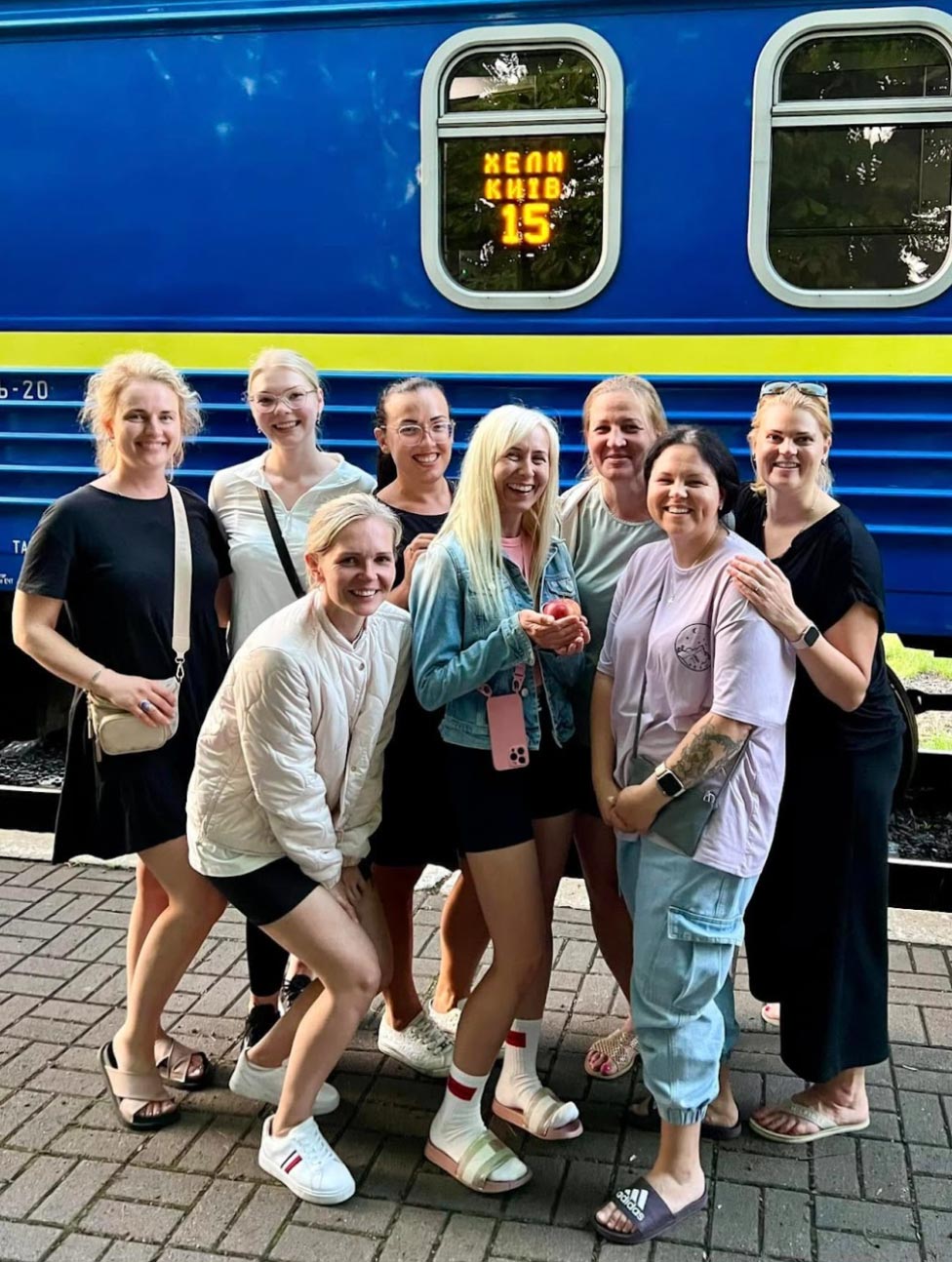
Teachers from Kohila Sipsiku on their way to Ukraine
What language do you communicate with each other in?
Teacher Teele:
“We started in English, but to convey longer thoughts we went with a written translation (Estonian ↔︎ Ukrainian translation). It works surprisingly well.”
Teacher Helina, did you have any specific ‘aha’ moments related to Ukraine?
Teacher Helina:
“Yes. I went to conduct an integrated art activity with scissors. On the spot, it turned out that the curriculum stated: children are not allowed to use scissors before the age of 5. There was a clear reluctance: “We have it like that, we can’t!” Instead of pushing, we talked about the ‘why’: two brain hemispheres, fine motor skills, eye-hand coordination, self-confidence.
At the end of the day, one teacher said: “We were completely against it at first, but we did it anyway – and we understood why it’s good for children.” The lesson? Openness and justification. When a teacher understands why something needs to be done, he or she is ready to try.”
Teacher Teele (adds):
“A similar pattern was with the availability of toys. In some groups, the materials were under the teacher’s ‘control’ – the child has to ask, they don’t even see what is there. When the materials are available to the child, more independent play, choices and responsibility arise.”
Teacher Helina:
“At one point, a young local translator joined our group. It made everything better. A native-speaking mediator makes the information soft and precise, relieves tension.
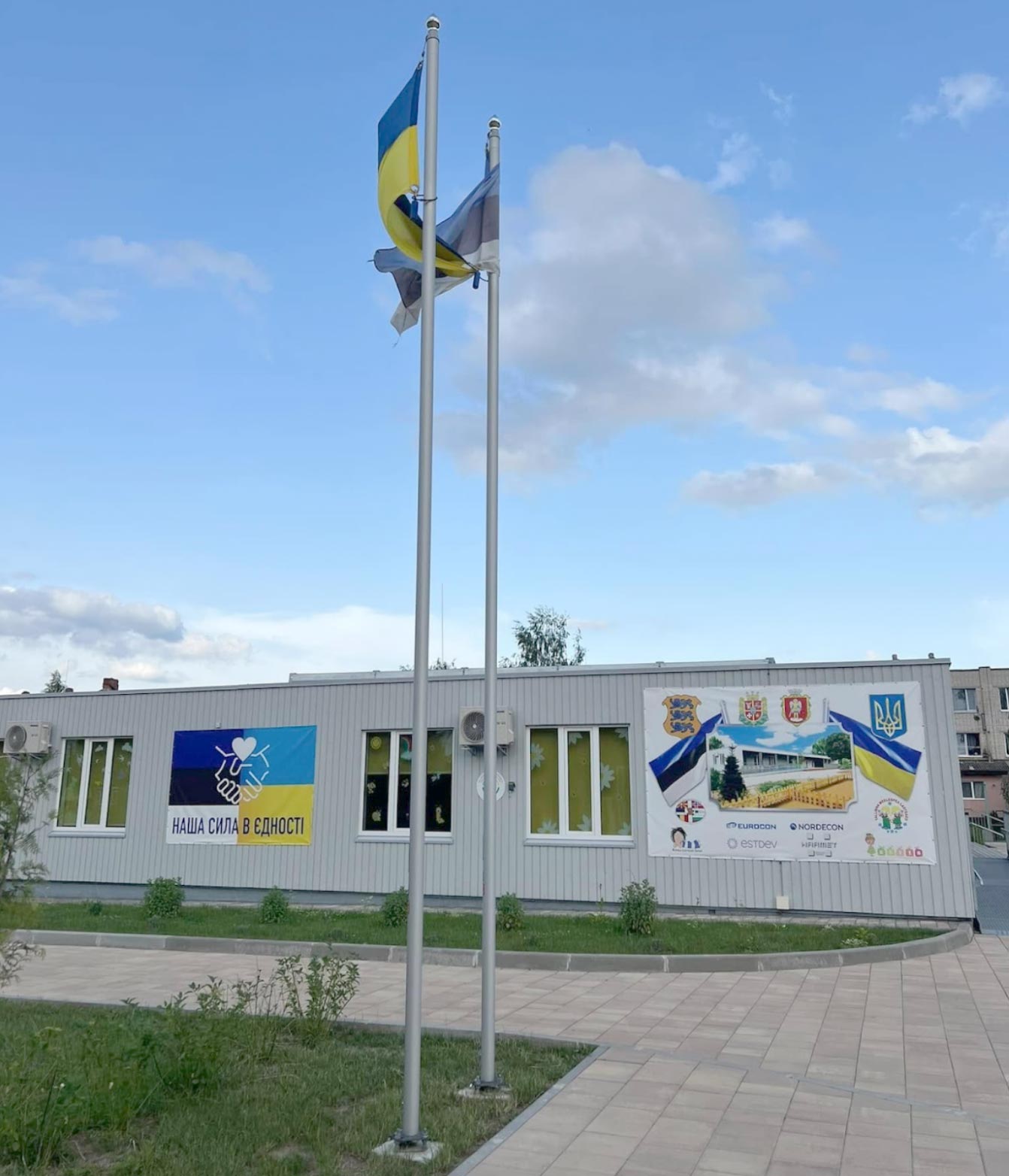
ESTDEV together with Estonian companies built a kindergarten in Ukraine, where the ELIIS platform is also in use
Eliisi is also already used in quite a few kindergartens in Ukraine. If we invited you, would you come to the webinar to talk about your experiences in Ukraine and give your thoughts to other Ukrainian kindergartens?
Teacher Teele:
“Yes, we are ready. Ukraine is a topic close to our hearts.”
Teacher Helina:
“Agreed. A small suggestion for the organization:
bring a translator (Ukrainian/Russian ↔︎ Estonian/English), ask each speaker to bring 1–2 very specific techniques (e.g. the ‘starter package’ of the peace nest, the ‘ladder’ of scissors exercises), and pictures/video fragments – practicality is the key word.”
Two key themes that were well received in Ukraine
Peace nests: how to think through a place with children; practice when there is peace (not just in a crisis); simple tools (breathing techniques, hourglass, soft ball, effort-relaxation).
Self-regulation micro-techniques for every day: rhythmic movement, where you add a word (“in – out”), a short pause before action, the teacher models.
Please tell one story each that has recently warmed your heart.
Teacher Helina:
“A new house, new children and parents – everyone is adjusting. One morning a parent came with a bag of oranges: “Good health!” Such small remarks – flowers, a warm word – make the day. And from the children’s side: when someone says completely by themselves: “It’s my birthday, and you are definitely invited!” – the feeling that I am a welcome person in the group is priceless.”
Teacher Teele:
“Every morning, when I hear from afar: “Teele!” and a child holds out his arms to hug me – I know that I am welcome. The greatest moments come from breakthroughs: when we find effective methods for a child with difficult behavior, the parent comes to cooperate and the child does not feel “bad”, but understood. When other children also learn to see that he sometimes has a hard time and give him the space he needs – it is very moving.”
Imagine the year 2050. What will be different in kindergartens?
Teacher Helina:
“A child-centered approach is the norm: free play and natural learning are the focus, not “let’s sit down and do a worksheet”. The pace is calmer. The groups are smaller so that every child can be reached. The day is shorter, like in Norway, so that families can spend more time together. And in every kindergarten yard there is a play yard – a paradise for free play.”
Teacher Teele:
“In addition, there are quiet spaces in every house and opportunities for exercise indoors (gymnasiums, swings), because exercise is also a prerequisite for reading and writing, for example, and also supports self-regulation. I want the work of a kindergarten teacher to be visibly valued in society and for natural learning to take place in kindergarten, in real situations – the child is an active participant in everything that is within his or her power to do himself or herself.”
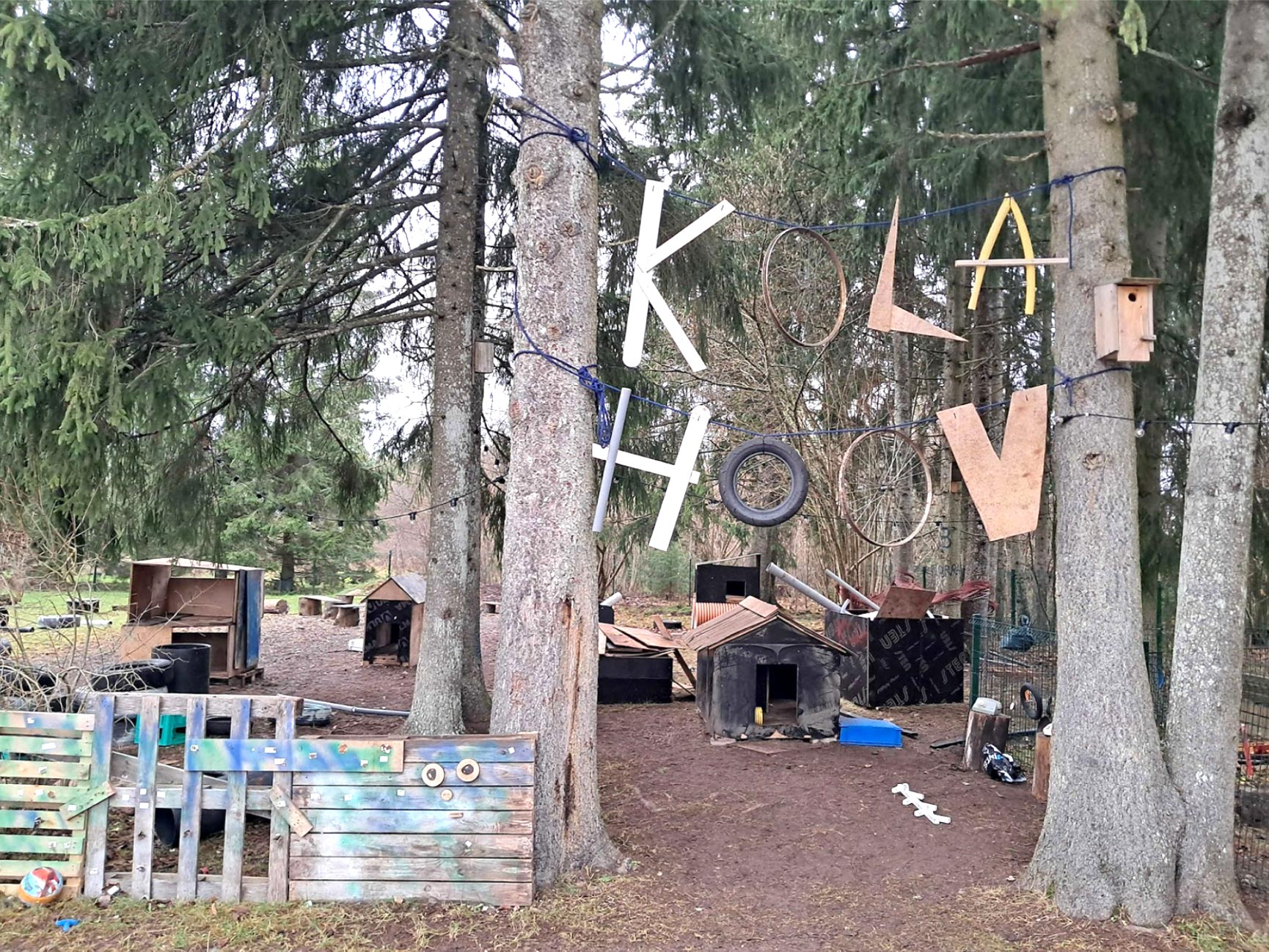
Scrap yard playground build by teachers and parents of Sipsik kindergarten which resulted being very very popular among all children
“Teachers could be more valued” – what does this mean for you?
Teacher Teele:
“A lot starts with awareness: that kindergartens do not “take care of children”, but rather create the foundation for an educational path. When the community sees what and why we do – attitudes change.”
Teacher Helina:
“For me, a sense of value is born from a trusting relationship with the family. I use the “Let’s Talk About Children” framework from Peaasi.ee: a one-hour conversation with the family right at the beginning – the parent is the expert on their child, I am the support. If all families receive the same structure and questions, an equal and clear relationship is created. This grows respect and cooperation.”
Would you recommend this program to other kindergartens?
Teacher Helina: “Definitely. A structured, equal and safe start with the family will support everything later.”
Closing statement
The story of Kohila Sipsik shows that a kindergarten can be warm, creative and very systematic at the same time. It is not created overnight or with one “big project”, but through annual development days, well-thought-out work organization, small agreements, honest feedback and the teachers’ courage to ask: does what we are doing really support the child?
Teacher Teele and teacher Helina’s thoughts give this story a human dimension. On one side is autonomy, professional freedom and high expectations for themselves. On the other side is the “thorny hedgehog”, nests of peace, a bag of oranges from a parent and children who shout “Teele!” from afar in the morning. In this relaxed, yet demanding combination, a culture is born where it is good to work and grow – for both children and adults.
Perhaps Sipsiku’s greatest strength is that they do not consider themselves a “ready-made” kindergarten.
A big thank you to Teele and Helina!